University of Nebraska Implements and Tests
Updated Nitrogen Recommendations
Observations from the University of Nebraska Eastern Nebraska Research, Extension and Education Center
The latest University of Nebraska research on nitrogen (N) management in irrigated corn focuses on increasing profitability and reducing the environmental impacts of with updated fertilizer use recommendations. Current, updated University of Nebraska recommendations emphasize in-season nitrogen application during the growing season rather than a blanket, one-size-fits-all approach for irrigated corn production.
The University of Nebraska has collected usable data and developed strategies for in-season N use that can be implemented at the farm level. The potential advantages in terms of yield, N savings, and environmental protection make in-season application/management a valuable asset for irrigated corn producers. While sensor-based technology has been tested for 30 years - over the last decade, University of Nebraska researchers have been partnering with farmers and testing in-season application through on-farm research, as well as in farm-scale research fields at University Research, Extension and Education Centers (REECs) and research sites.
During the 2025 growing season, the Eastern Nebraska Research, Extension and Education Center facilities implemented the updated N recommendations. Here's a brief update from the Eastern Nebraska Research, Extension and Education Center near Mead, NE; Haskell Ag Lab near Concord, NE; and South Central Ag Lab near Clay Center, NE.
About the Recommendations
Joe Luck leads the University’s NFarms (Nebraska Future Ag Research & Management Systems) initiative and is also the associate director at the Eastern Nebraska Research, Extension and Education Center. Luck, a professor of Biological Systems Engineering and precision agriculture engineer (and currently serving as interim department head), has dedicated considerable effort to studying and implementing strategies for optimizing N use in irrigated corn. His research supports that it is possible to achieve healthy crops with less nitrogen. He emphasizes the importance of timing and data-driven decisions.
Based on University research, the three key recommendations are:
- Spring Application: Apply a base rate of 50–100 pounds of nitrogen per acre.
- In-Season Application: Apply nitrogen during the growing season, specifically between the V8 and R2 growth stages for optimal plant use and yield.
- Sensor-Based Methods: Consider sensor technology to make data-driven decisions.
The traditional approach to nitrogen application usually involves proactive applications in the fall and spring. The timing of the updated, recommended in-season applications coincides with the plants' rapid uptake period instead. When combined with sensor-based application, efficiency is greatly improved because sensors detect plant stress that is not visible to the naked eye.
On the importance of N research at University locations, Luck said, "There is value in utilizing both growers’ fields for on-farm research and University research fields. When doing studies in University fields, the risk level can be amplified to a level that growers might not be comfortable trying."
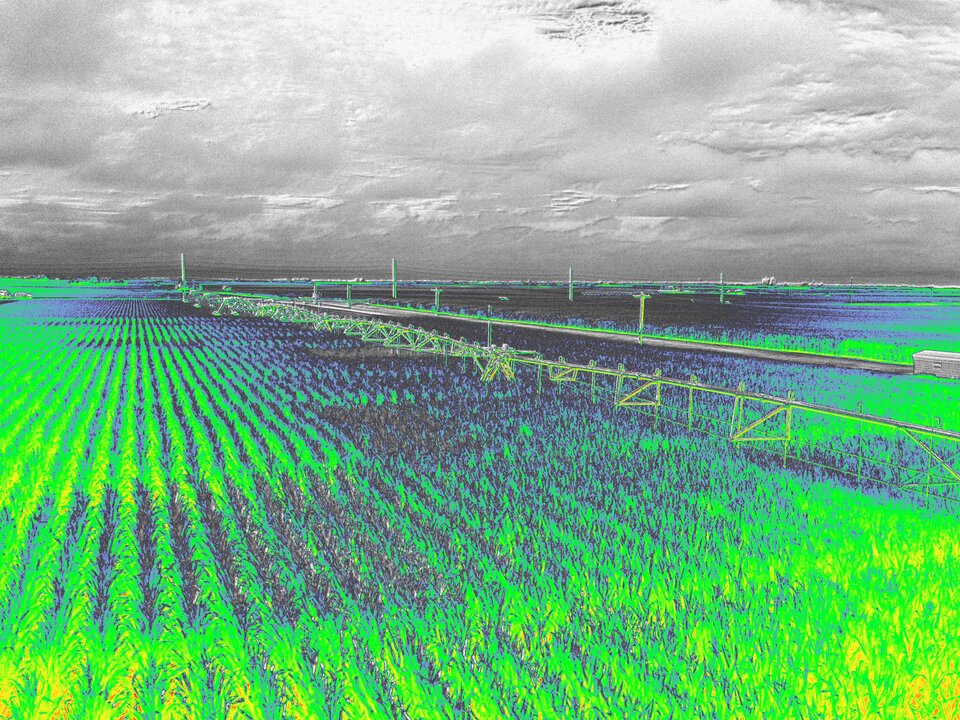
Sensor-based technology can detect corn stress at least a week before it can be detected by sight. Sensors can be used onboard UAVs, mounted on satellites, and on high clearance equipment. Knowing the differences within a field helps quantify them and is instrumental in determining the best course of action for N application in the variances. 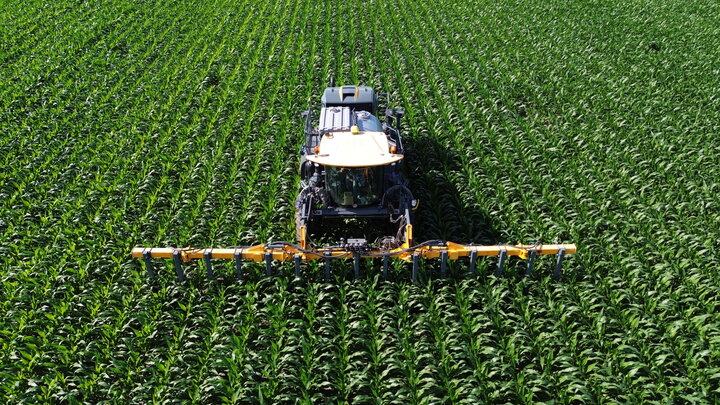
|
Using the updated N recommendations at ENREEC Facilities
Eastern Nebraska Research, Extension & Education Center near Mead, NE
At the University of Nebraska Eastern Nebraska Research, Extension and Education Center (ENREEC), over 400 acres were utilized in 2025 for implementing bulk nitrogen management changes and conducting research to enhance nitrogen management.
In incorporating the updated recommendations at ENREEC, standard anhydrous application rates were reduced to half. The remaining nitrogen needs were managed throughout the season using sensor-based fertigation. On rainfed fields, half the usual anhydrous rate was applied and a sensor-driven prescription was utilized for side-dressing at the V10 growth stage in corn.
With livestock onsite at ENREEC, research includes incorporating manure into field studies. The manure application rate was reduced on some fields. This strategy kept the nitrogen component low enough leaving room for any additional nitrogen requirements to be managed effectively.
ENREEC partnered with Sentinel Ag to develop prescriptions for sensor-based fertigation. Sensors and imagery detected crop health/needs to avoid overapplying nitrogen.
ENREEC research manager Tyler Smith noted that the nitrogen reductions have been impressive so far. Like anything in farming, there are challenges when trying something new. Smith noted. “The biggest challenge is in the unknown, such as determining how much fertilizer is needed for the year. And with rainfed, the challenge is knowing when the application needs to take place.”
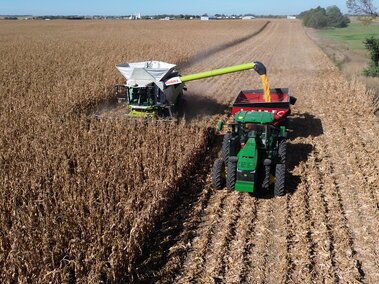
At the University of Nebraska Eastern Nebraska Research, Extension and Education Center (ENREEC), over 400 acres were utilized this year for implementing bulk nitrogen management changes and conducting research to enhance nitrogen management.
Reduction in N points towards higher yield results in 2025. Let's take a closer look at studies done in 2 ENREEC fields.
We asked ENREEC research manager Tyler Smith to walk us through studies from two different fields at ENREEC and provide a quick look at the outcomes. Here's a quick overview.
Field 1 - Irrigated field utilized for bulk corn production. Sentinel monitored the field using N-Time platform.
80 lbs. N/ac with UAN (Urea Ammonium Nitrate) liquid fertilizer was applied right before planting to set up indicator blocks in the irrigated portion of the field. The indicator block utilized fixed amounts of Nitrogen, to gauge crop response compared to the rest of the field. A canary block (low-N block) was included in the indicator block with 50 lbs. N/ac and the reference block (high-N block) with 140 lbs. N/ac. In the dryland corners, 140 lbs. N/ac was applied.
Using the Sentinel Ag N-Time® platform, 1 of the 3 indicator blocks triggered a need/recommendation for additional nitrogen for only 1 day in mid-June, but the next day it showed that it was sufficient. Fertigation was never triggered for the rest of the season. So no fertigation application was made to Field 1 in 2025.
Field 1 was harvested for high moisture corn on September 16, 2025. Analyzation of the results shows there was no increase in yield in the reference plots where more nitrogen was applied, in fact, the yield was lower than the bulk area of the field that received 80 lbs. N/ac.
Plot | Lbs-N/ac Applied | Yield bu/ac |
Bulk | 80 | 192.8 |
Canary | 50 | 189.4 |
Reference | 140 | 184.3 |
Rainfed Corner | 140 | 180.8 |
Field 2 - Irrigated field utilized for bulk corn production. Sentinel monitored the field using N-Time platform.
70 lbs. N/ac was applied to the bulk, irrigated part of the field. There were 3 indicator blocks established with that application with 40 lbs. N/ac for the canary plots, and 130 lbs. N/ac for the reference plots. The rainfed corners received 140 lbs. N/ac. The field also received 140 lbs/ac of MAP fertilizer.
Field 2 did not trigger a need for additional nitrogen/fertigation event, so no additional nitrogen was applied.
Field 2 was harvested for silage on September 6, 2025. Spatial yield information was captured with John Deere Harvest Lab equipment mounted on a silage chopper. Data analyzation shows there was no significant tonnage difference between the bulk area of the field and the reference plots that received 60 lbs. N/ac more. There was a drop-off in tonnage between the bulk area and the canary plots, indicating that no excess nitrogen was applied and that any further reduction would have resulted in yield loss.
| lbs. N/ac Applied | Treatment | Moisture, % | Forage Yield, dry tons/ac |
140 | Rainfed Corner | 62.2 | 10.1 |
70 | Bulk | 62.2 | 10.1 |
130 | Reference | 63.7 | 9.9 |
40 | Canary | 63.7 | 9.4 |
Data analysis is ongoing and research will continue in 2026. Updates coming soon.
Haskell Ag Lab near Concord, NE
At the Haskell Agricultural Laboratory near Concord, Nebraska, Nitrogen management research using the updated University recommendations was conducted across 175 acres in 2025. Nitrogen application techniques utilized to assess their effectiveness included: late fall anhydrous application with 12.5 acres at a rate of 160 pounds per acre applied in late fall. Spring application included 12.5 acres at a rate of 160 pounds per acre, as well. A preplant application of 20 gallons with liquid 32 per acre (equating to 71 pounds of Nitrogen) was combined with herbicide application.
The University encounters some of the very same challenges that farmers face, not everything always goes as planned. Logan Dana, Haskell Ag Lab Operations Manager noted, "The plan was to apply the remaining Nitrogen with a variable rate sprayer with drop nozzles sometime between V8 and V10 growth stages of the corn. However, because of the rain, the corn grew too fast, and we missed our window of application and were forced to hire a highboy to put a blanket application of urea on 100 acres."
For the remaining acres: 35 acres were fertilized with chemigation and 40 acres were fertilized with a sprayer with drop nozzles.
Watch for further updates on results from 2025 implementation.

South Central Ag Lab near Clay Center, NE
Guillermo Balboa is leading nutrient management research on irrigated corn at the South Central Agricultural Laboratory (SCAL) near Clay Center. Balboa is a research assistant professor with UNL’s Department of Agronomy and Horticulture. He specializes in nutrient management and digital agriculture. Balboa is heavily involved in studying and developing decision support tools that can help farmers in their decision-making process. Balboa is part of the University of Nebraska team that developed updated in-season nitrogen management recommendations for irrigated corn.
In 2025 at SCAL, UNL continued implementing updated N recommendations for irrigated corn. Traditional nitrogen management at the SCAL involved a full N rate applied at 75 lbs/ac in early spring as anhydrous ammonia and 32% liquid urea. As part of the University's efforts to improve NUE of around 75 lbs/ac, following UNL recommendations, the research station across 260 acres of all bulk production areas and followed up with an in-season side-dress application of N to meet the N requirements (side dress average rate 100 lbs N/ac). Preplant N application was reduced to 100 lbs/ac on old corn ground and 80 lbs/ac on old soybean ground.
In partnership with the Digital Farming Lab led by Dr. Balboa, recommendations were made based on multispectral imagery collected by the Farm team. The farm was equipped this year with a new multispectral drone and has trained pilots to collect imagery. These imagery-based recommendations were performed in three fields, totaling 120 acres. In these fields, N ramp plots were established to determine timing and amount of fertilizer needed. After harvest, the Economic Optimum Nitrogen Rate is determined, which is critical for assessing how efficient the N management program is.
At one of the center pivot fields, SCAL continues evaluating fertigation strategies in partnership with Sentinel Ag. This technology has consistently increased efficiency and profits in previous years by reducing the total N rate applied. In seasons where commodity prices are low and inputs price rises, increasing efficiency via the implementation of technology can help farmers navigate the complex scenario.
Dr. Balboa is the PI of the Precision Nitrogen Management Conservation Innovation Grant (CIG-USDA). The Precision N CIG project started in 2021 and conducted +120 On Farm Research studies evaluating precision N practices with Nebraska Farmers. This project is possible through a grant from the U.S. Department of Agriculture's (USDA) Natural Resource Conservation Service (NRCS). Technologies evaluated were sensor-based approaches (for dryland and irrigated corn), crop models, biologicals and inhibitors. Dr. Balboa, among other researchers, continues conducting N-related research at SCAL to produce better recommendations for farmers in the area and Nebraska.
Watch for more detailed information on 2025 implementation and results.
Learn more about the updated recommendations:
In-Season Nitrogen Management for Irrigated Corn g2365
https://extensionpubs.unl.edu/publication/g2365/in-season-nitrogen-management-for-irrigated-corn